
Today, parents are looking beyond examination results and asking a much broader question: What kind of environment will help my child learn, grow, discover their strengths and prepare for the future?
A good school should provide strong academics, but education cannot end with textbooks and examinations. Children also need opportunities to play, create, communicate, experiment, collaborate and lead.
This is the philosophy behind Homerton Grammar School, Faridabad. With a legacy of more than four decades, the school combines academic learning with sports, arts, technology, leadership opportunities and values-based education. Its approach is designed to nurture intellectual, physical, creative, social and emotional development alongside academic achievement.
For parents researching CBSE schools in Faridabad, looking inside the school can provide a better understanding of what everyday learning actually looks like. From smart classrooms and science laboratories to sports arenas, performing arts studios, robotics and AI facilities, and leadership platforms such as Model United Nations, Homerton Grammar provides students with multiple ways to discover and develop their potential.
A school built around holistic development
Education is changing rapidly. Students today need more than subject knowledge. They need critical thinking, communication, creativity, collaboration, adaptability, confidence and problem-solving skills.
Homerton Grammar School’s educational philosophy places holistic development at the centre of learning. The school focuses on building a strong academic foundation while encouraging critical thinking, creativity, communication, teamwork and modern learning approaches.
The result is an environment where academics, sports, arts, technology and leadership are not treated as completely separate experiences. Instead, they complement one another.
A student solving a robotics problem is learning persistence and teamwork. A student participating in a sports competition is learning discipline and resilience. A student performing on stage is developing confidence and communication. A student participating in an MUN is learning research, diplomacy and leadership.
Together, these experiences contribute to a more complete education.
1. Academics: Building strong foundations for lifelong learning
Academic learning remains at the heart of every school experience, and Homerton Grammar School places considerable emphasis on creating strong conceptual foundations.
The school’s classrooms are designed to support age-appropriate learning across Early Years, Primary, Middle and Senior School. Its campus includes fully air-conditioned smart classrooms supported by digital tools, projectors and modern teaching infrastructure.
But effective academics are about much more than classroom technology.
Homerton Grammar’s approach emphasises understanding children at different stages of their development and providing individual attention. The school describes its academic methodology as one that considers biological, psychological and social dimensions of childhood while maintaining an emphasis on student development.
Learning beyond rote memorisation
Modern education requires students to understand why something works rather than simply remember an answer.
This is why Homerton Grammar School encourages:
- Critical thinking
- Problem-solving
- Creativity
- Questioning
- Conceptual understanding
- Experiential learning
- Communication
- Collaborative learning
The school also invests in continuous teacher development. Its teacher-training programmes include activity-based learning, collaborative and experiential approaches, assignment design, feedback mechanisms and technology integration.
This combination of trained educators, modern classrooms and student-centred learning helps create an academic environment where children can engage actively with what they learn.
Academic achievement with a broader perspective
Strong academic performance remains an important outcome, particularly for students preparing for CBSE board examinations.
Homerton Grammar’s published 2025-26 results highlight strong performances across Science, Commerce and Humanities, including high scores in subjects such as Mathematics, Biology, Chemistry, Accountancy, Economics, Mass Media and Painting.
However, the goal is not simply to prepare students for one examination.
It is to develop learners who can continue learning long after school.
2. Sports: Learning discipline beyond the classroom
Walk into a school playground, and you can often see a different side of a child.
A student who may be quiet in class may become a confident team player on the field. Another may discover an unexpected talent for athletics, badminton, cricket or gymnastics.
At Homerton Grammar School, sports are considered an integral part of holistic development.
The school has a dedicated two-acre indoor and outdoor sports complex within its larger campus and provides opportunities across a wide range of sporting disciplines.
Students can participate in sports including:
- Cricket
- Football
- Basketball
- Badminton
- Lawn tennis
- Hockey
- Athletics
- Gymnastics
- Table tennis
- Pickleball
- Chess
- Carrom
- Kabaddi
- Taekwondo
- Yoga
The school’s sports programme is designed to introduce students to physical activity from an early age and provide opportunities for progression as they grow. Its sports programme has also included dedicated coaching and after-school academies.
Sports teach more than fitness
The value of sports extends beyond physical health.
Students learn to:
- Work as a team
- Respect opponents
- Follow rules
- Handle success and disappointment
- Stay committed to practice
- Manage time
- Take responsibility
- Persevere when things become difficult
These are life skills.
Whether a student eventually becomes a professional athlete or simply enjoys playing a sport throughout life, the lessons learned on the field can influence their confidence and character.
Homerton Grammar School also provides structured sports opportunities, including the Homerton Cricket Academy and competitive participation through inter-house, inter-school and higher-level competitions. The school has additionally introduced Trinity Sports Scholarships for students who have demonstrated achievements at state and national levels.
3. Arts: Giving children a voice through creativity
Not every child expresses themselves through mathematics or science.
Some discover their confidence through painting. Others find their voice through music, dance, theatre, photography or design.
That is why arts education plays an important role at Homerton Grammar School.
The school provides dedicated spaces for creative and performing arts, including art rooms, a music studio and a dance studio. Students have opportunities to explore different forms of creative expression and showcase their talents through exhibitions, performances and school events.
Music and dance
The school’s music studio supports both vocal and instrumental learning, while its dance studio exposes students to classical, contemporary and folk dance forms.
Performing arts can help children develop:
- Confidence
- Stage presence
- Creativity
- Coordination
- Communication
- Self-expression
- Concentration
- Teamwork
Homerton Grammar’s Trinity Hall, its multipurpose auditorium, provides another platform for performances, concerts, theatre, dance competitions, award ceremonies and cultural programmes. The auditorium includes acoustic and visual facilities as well as rehearsal spaces.
These experiences help students understand that creativity is not simply about producing something beautiful.
It is also about taking an idea and turning it into something meaningful.
4. Technology: Preparing students for a digital future
Technology is transforming almost every industry, making digital literacy an essential part of modern education.
At Homerton Grammar School, technology is integrated into learning through ICT facilities, smart classrooms and a dedicated Robotics & Artificial Intelligence Lab.
The school states that its Robotics & AI Lab serves students from Grade II to Grade XII and includes robotics kits, AI tools, coding resources, a 3D printer and other technology resources.
From technology users to technology creators
The most valuable technology education does not simply teach children how to use devices.
It teaches them how to think.
Through robotics and coding, students can learn to:
- Break complex problems into smaller steps
- Develop logical thinking
- Experiment with ideas
- Identify errors
- Test solutions
- Collaborate with others
- Think creatively
- Build and innovate
The school also has an ICT and Computer Lab with more than 30 desktop computers, alongside its robotics and AI infrastructure.
This hands-on approach can make technology more meaningful because students move from simply consuming information to experimenting, creating and solving problems.
Future-ready learning
Artificial Intelligence, coding, robotics and digital communication are increasingly influencing higher education and careers.
Introducing students to these areas at school can help them become more comfortable with emerging technologies while developing transferable skills such as computational thinking, creativity and problem-solving.
For parents searching for a future-ready CBSE school in Faridabad, technology-rich learning can therefore be an important factor to consider.
5. Leadership: Preparing students to take responsibility
Leadership is often misunderstood as simply being the person at the front of a group.
True leadership is broader.
It involves listening, communicating, making decisions, accepting responsibility, collaborating with others and having the confidence to act.
Homerton Grammar School provides students with multiple opportunities to develop these qualities through competitions, presentations, collaborative projects, student participation, sports, cultural programmes and leadership platforms. The school’s stated philosophy specifically focuses on developing future global leaders who combine academic excellence with social awareness.
MUN: Leadership through real-world discussion
One of the school’s notable leadership platforms is Ekatva MUN.
Homerton Grammar hosted its inaugural two-day Model United Nations conference in 2025, bringing together students from Grade 6 onwards to participate in diplomatic simulations and discussions around global and national issues. Committees included the United Nations General Assembly, UN Commission on the Status of Women, All India Political Parties Meet, IPL Auction Committee and International Press.
The school subsequently organised Ekatva 2.0, its intra-school Model United Nations, with an explicit focus on leadership, diplomacy, critical thinking, public speaking and collaborative problem-solving.
MUN experiences can help students learn to:
- Research complex topics
- Present arguments
- Listen to opposing viewpoints
- Speak confidently
- Negotiate
- Collaborate
- Think independently
- Make informed decisions
These are skills that can prove valuable regardless of the career a student eventually chooses.
6. Communication: Helping students find their voice
Academic knowledge has limited impact if students cannot communicate their ideas.
At Homerton Grammar School, communication is developed through multiple academic and co-curricular experiences.
Presentations, debates, public speaking, cultural programmes, MUNs, competitions and collaborative projects provide students with opportunities to express their ideas before different audiences.
This can be particularly valuable during adolescence, when students are gradually developing their individual identity and learning to communicate their opinions with confidence.
The objective is not to make every student outspoken.
It is to help every student become comfortable expressing themselves.
7. Leadership through sports, arts and everyday participation
Leadership does not only happen during formal leadership events. It can happen on the sports field when a student encourages teammates.
It can happen during a theatre production when a student takes responsibility for a role.
It can happen in a robotics team when one student helps others solve a technical challenge.
It can happen during a school event when students coordinate tasks.
This is why a holistic school environment can be so valuable.
At Homerton Grammar, sports, performing arts, competitions and student-led experiences create multiple opportunities for students to take initiative and work with others. The school’s broader philosophy also emphasises leadership, community service and active student participation.
8. A campus designed for multiple dimensions of learning
The physical environment of a school can influence how children learn.
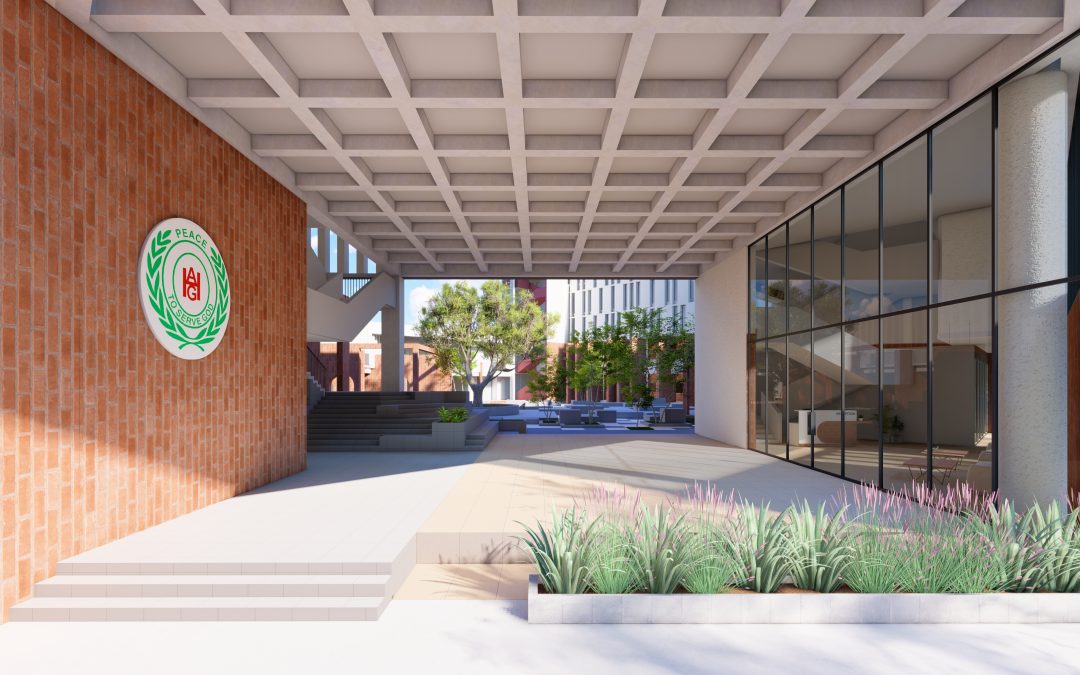
Homerton Grammar School’s campus spans approximately five acres and includes academic spaces, sports infrastructure, laboratories, cultural facilities and learning resources.
The campus includes:
- Smart classrooms
- Science laboratories
- ICT and computer facilities
- Robotics and AI laboratory
- Music studio
- Dance studio
- Art spaces
- Library
- Indoor and outdoor sports facilities
- Multipurpose auditorium
- Infirmary
- Cafeteria
- Transportation facilities
The purpose of this infrastructure is not simply to make the campus impressive.
The right infrastructure gives students spaces in which to learn by doing.
A science lab allows experimentation.
A sports ground allows practice.
A music studio allows performance.
A robotics lab allows innovation.
A library allows independent exploration.
An auditorium allows students to step onto a stage.
Together, these spaces create a learning ecosystem.
9. Academics + Sports + Arts + Technology = A more complete education
One of the biggest advantages of a holistic school is that children are not forced to define themselves by one ability.
A student can be academically strong and enjoy cricket.
Another can love mathematics and theatre.
Another can be interested in coding and painting.
Another may discover leadership through MUN or sports.
Children are multidimensional, and their education should reflect that.
Homerton Grammar’s approach brings these different dimensions together rather than treating them as competing priorities. Its own academic and co-curricular philosophy emphasises the importance of intellectual, physical, emotional, creative and social development.
This balance can help students discover strengths that may not be immediately visible through examination scores.
10. Building responsible global citizens
The ultimate objective of education is not simply academic success.
Students will eventually enter universities, workplaces and communities where they will need to interact with people who have different backgrounds, perspectives and experiences.
Homerton Grammar School therefore places emphasis on values, empathy, teamwork, social awareness and responsible citizenship alongside academic learning.
Community service and programmes such as the Duke of Edinburgh’s Awards/International Award for Young People provide additional opportunities for students to develop responsibility and engagement beyond the classroom.
This approach encourages students to ask not only: ‘What can I achieve?’
But also: ‘How can I contribute?’
That distinction can shape the kind of adults children eventually become.
What makes Homerton Grammar School different?
For parents comparing CBSE schools in Faridabad, the differences between schools may sometimes appear to be limited to infrastructure, examination results or fee structures.
A closer look, however, reveals that the educational experience is much broader.
At Homerton Grammar School, students have opportunities to:
- Learn through strong academics and modern pedagogy
- Play through structured sports and physical education
- Create through art, music, dance and cultural activities
- Innovate through robotics, AI, coding and technology
- Communicate through presentations, performances and public-speaking platforms
- Lead through MUNs, competitions, collaborative activities and student participation
- Serve through community-oriented experiences
This combination creates an environment where students can develop not just what they know, but also how they think, communicate and respond to the world around them.
What should parents look for when choosing a school?
Parents visiting schools in Faridabad can use a simple checklist:
- Academic Environment
Does the school focus on understanding rather than rote memorisation? - Teacher Support
Do teachers provide personalised guidance and meaningful feedback? - Sports
Are sports available as a regular part of school life rather than an occasional activity? - Arts
Are students given dedicated spaces and opportunities for creative expression? - Technology
Does the school expose students to relevant technologies such as coding, robotics and AI? - Leadership
Are students given genuine opportunities to take responsibility and make decisions? - Communication
Does the school help students develop confidence in speaking and presenting their ideas? - Values
Does the school focus on empathy, discipline, responsibility and social awareness? - Infrastructure
Does the campus provide spaces that support different forms of learning?
These questions can help parents look beyond brochures and understand the actual educational experience.
Inside Homerton: Preparing students for more than exams
A school is ultimately measured not only by what students score but also by who they become.
At Homerton Grammar School, the vision is to create confident, capable and responsible young people who are prepared to navigate a changing world.
The combination of academics, sports, arts, technology and leadership gives students multiple avenues to discover their interests and develop their strengths.
A child may enter school with a particular talent.
But the right environment can help that talent grow into confidence.
A curiosity can become an innovation.
A hobby can become a passion.
A team experience can become leadership.
A classroom lesson can become a lifelong love of learning.
That is the larger purpose of education.
Conclusion
For parents searching for the best CBSE school in Faridabad, the decision should go beyond marks, rankings or impressive infrastructure.
Look inside the school.
Look at what happens inside classrooms.
Look at how children spend their time on the sports field.
Look at whether they have opportunities to create and perform.
Look at how technology is used.
Look at whether students are encouraged to speak, question, experiment and lead.
Because the strongest education does not prepare children only for the next examination.
It prepares them for the next chapter of life.