
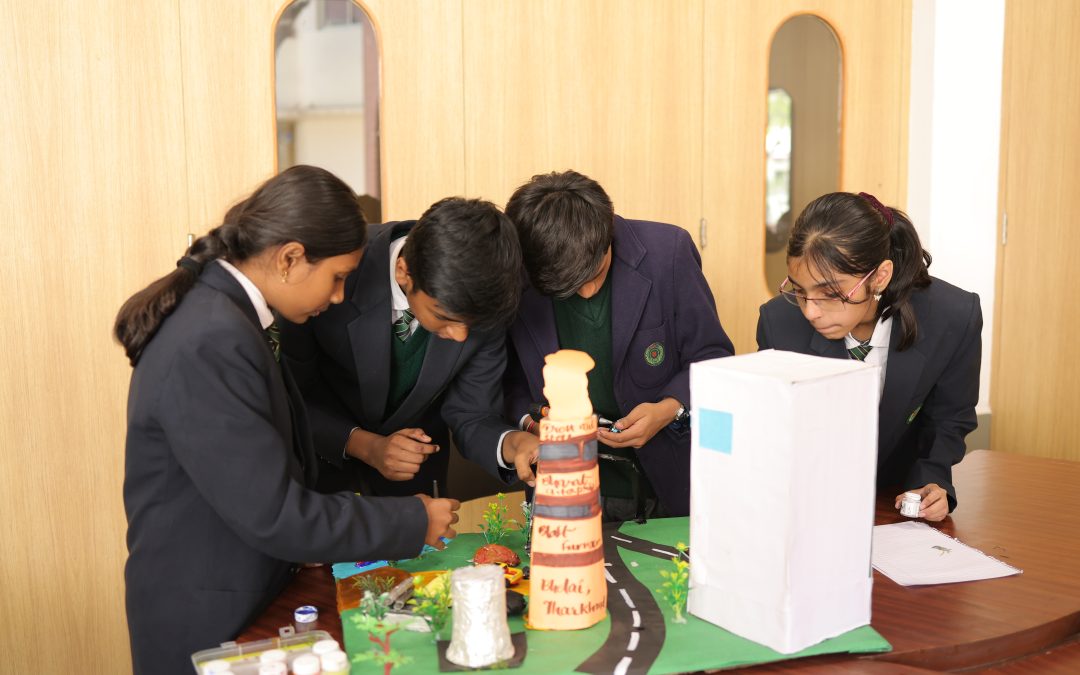
For generations, education has been associated with textbooks, classroom lectures, written assignments and examinations. While these remain important parts of academic learning, the world today demands much more from students. Understanding a concept is important, but knowing how to apply it in real-life situations is equally valuable.
Imagine a student learning about electricity through a science textbook. They may memorise definitions, understand diagrams and answer examination questions. However, when they get an opportunity to build a simple electrical circuit in a laboratory, the concept becomes more meaningful. They can observe how components work together, identify mistakes, experiment with different possibilities and understand the science behind what they have studied.
This is the value of practical learning. As education continues to evolve, schools must create opportunities for students to move beyond theoretical knowledge and engage with the world through experiments, projects, technology, sports, creative activities and collaborative experiences.
For parents exploring the best CBSE schools in Faridabad, understanding how an institution integrates practical learning into its curriculum is an important part of the school selection process.
At Homerton Grammar School, the emphasis extends beyond textbooks and examinations. Through science laboratories, Robotics and Artificial Intelligence facilities, Coding, Mass Communication, sports and creative activities, students get opportunities to explore their interests and develop skills that support their overall growth.
Let’s understand why practical learning matters, how it benefits students and what parents should look for when choosing a school.
1. What is practical learning in schools?
Practical learning is an educational approach that allows students to understand concepts by applying knowledge through activities, experiments, demonstrations, projects and real-world experiences.
Instead of relying exclusively on listening to explanations or memorising information, students actively participate in the learning process.
For example:
- Science students perform experiments to understand scientific principles
- Mathematics students use measurements and real-life examples to explore mathematical concepts
- Technology students learn through coding exercises and robotics projects
- Language students develop communication skills through debates, presentations and public speaking
- Social science students understand history and geography through models, research and interactive projects
- Students develop physical and interpersonal skills through sports and team activities
Practical learning does not replace textbooks or classroom teaching. Instead, it complements theoretical knowledge by helping students understand how concepts work in different situations.
The combination of theoretical understanding and practical application makes learning more engaging, relevant and meaningful.
2. Why is practical learning important for students?
The purpose of education is not simply to help children score well in examinations. It should also prepare them to think independently, solve problems, communicate effectively and adapt to new situations.
Practical learning contributes to these abilities in several ways.
A. Helps students understand concepts better
One of the biggest advantages of practical learning is that it makes abstract concepts easier to understand. Some subjects involve ideas that students may find difficult to visualise through written explanations alone.
For instance, understanding the human digestive system through a textbook provides theoretical knowledge. Observing a model or participating in an activity can help students understand how different organs work together.
Similarly, science experiments allow students to observe chemical reactions, understand physical forces and explore biological processes.
When students see concepts in action, they can connect classroom knowledge with practical experiences.
B. Encourages curiosity and exploration
Children are naturally curious. They ask questions, observe their surroundings and try to understand how things work. Practical learning encourages this curiosity instead of limiting students to predefined answers.
A classroom experiment, robotics activity or group project can encourage children to ask questions such as:
- Why did this happen?
- What would happen if we changed something?
- Can we find another way to solve this problem?
- How can we improve our results?
Such questions encourage students to explore ideas independently and develop a deeper interest in learning.
C. Develops problem-solving abilities
Real-life situations rarely come with ready-made answers. Students need to understand a problem, analyse available information, consider different solutions and make decisions. Practical activities provide opportunities to develop these abilities.
For example, when students work on a group project, they may encounter challenges related to planning, resources or execution. They must discuss possible solutions, divide responsibilities and work together to complete the task. These experiences encourage logical thinking, decision-making and problem-solving.
D. Builds confidence and independence
Practical learning allows students to take an active role in their education. Whether they are conducting an experiment, delivering a presentation, participating in a debate or completing a project, students get opportunities to express their ideas and demonstrate their abilities. Successfully completing an activity can help build confidence.
Students also learn to take responsibility for their work, manage tasks and make decisions independently.
Over time, these experiences can help them become more comfortable with challenges and unfamiliar situations.
E. Improves knowledge retention
When students actively participate in learning, they have more opportunities to connect new information with existing knowledge.
For example, a student who learns about plant growth through an activity involving seeds, soil, water and sunlight can observe the process over time.
This creates a connection between scientific explanations and real-life observations.
Practical experiences can therefore make certain concepts easier to recall and apply.
However, effective learning still requires explanation, reflection, revision and regular practice.
3. How practical learning makes different school subjects more interesting?
Practical learning can be integrated into almost every subject. It does not need to be restricted to science laboratories or technology classrooms.
Here is how different subjects can become more engaging through hands-on experiences.
Science: Learning through experiments
Science is one of the most natural areas for practical learning. Laboratory experiments help students understand scientific principles through observation and investigation.
Some examples include:
- Observing chemical reactions in Chemistry
- Studying plant cells and biological structures in Biology
- Exploring motion, force and electricity in Physics
- Understanding ecosystems through environmental activities
- Conducting simple experiments to investigate everyday scientific phenomena
Science laboratories encourage students to observe carefully, record findings, analyse results and understand the importance of accuracy.
Mathematics: Connecting numbers with real life
Mathematics becomes more meaningful when students understand how it is used beyond examinations. Teachers can introduce activities involving measurements, budgeting exercises, shapes, patterns, data collection and calculations.
For example, students can explore geometry through models, understand percentages through practical examples and learn statistics by collecting and analysing classroom data.
These activities help students recognise the relevance of mathematics in everyday life.
Languages: Learning through communication
Language learning is not limited to grammar rules and written exercises.
Students need opportunities to communicate, express opinions and understand different perspectives.
Activities such as debates, storytelling, role-play, creative writing, presentations and public speaking help students develop vocabulary, fluency and confidence.
They also learn to listen actively, organise thoughts and communicate ideas clearly.
Social Science: Understanding the world around us
Social science concepts can be explored through maps, models, research projects, historical timelines, group discussions and community-based activities.
For example, students can create geographical models, study local communities or prepare presentations about historical events.
Such activities help connect textbook information with the world around them.
4. The role of Science laboratories in practical education
Science laboratories are among the most important facilities parents should evaluate when choosing a school.
A well-equipped laboratory provides students with opportunities to explore scientific concepts through structured experiments and guided activities.
Different laboratories serve different learning objectives.
Physics laboratory: Helps students explore concepts such as motion, force, electricity, light, energy and magnetism.
Chemistry laboratory: Introduces students to chemical reactions, materials, solutions and the properties of different substances.
Biology laboratory: Provides opportunities to understand living organisms, cells, plant structures, human anatomy and biological processes.
Laboratory-based learning also encourages important habits such as following instructions, maintaining records, observing carefully and working responsibly.
At Homerton Grammar School, students have access to Physics, Chemistry and Biology laboratories that support practical engagement with scientific concepts.
These learning spaces complement classroom teaching and help students develop an interest in scientific exploration.
5. Robotics, artificial intelligence and coding: Preparing students for the future
Technology is transforming almost every industry, making digital literacy and technological understanding increasingly important.
Introducing students to emerging technologies at school can help them understand the possibilities of innovation and develop relevant skills.
Robotics: Turning ideas into working models
Robotics introduces students to the relationship between mechanical components, electronics, programming and logical thinking.
Through guided activities, students can understand how machines respond to instructions and how different components work together.
Building and exploring robotic models can encourage creativity, experimentation and problem-solving.
Artificial intelligence: Understanding emerging technology
Artificial Intelligence is becoming an important part of everyday life.
Introducing students to AI concepts can help them understand how technology processes information, recognises patterns and supports different applications.
Age-appropriate learning can also introduce discussions around responsible technology use, digital ethics and the importance of human decision-making.
Coding: Developing logical thinking
Coding teaches students how to break down problems into smaller steps and communicate instructions to computers.
It encourages logical reasoning, sequencing, creativity and structured thinking.
Students can explore basic programming concepts through interactive activities and projects suited to their learning levels.
At Homerton Grammar School, opportunities in Robotics, Artificial Intelligence and Coding introduce students to new-age learning and encourage them to explore technology beyond conventional classroom lessons.
6. Project-based learning: Learning through collaboration
Project-based learning allows students to explore a topic or solve a problem through a structured project.
Instead of studying information in isolation, students work towards creating something, investigating a question or presenting their findings.
For example:
- Designing a model of a sustainable city.
- Creating a working science model.
- Preparing a research presentation on environmental conservation.
- Developing a campaign about responsible water usage.
- Building a basic robotic project.
- Creating a school magazine or multimedia presentation.
These projects often involve research, planning, collaboration, communication and presentation.
Students learn how to divide responsibilities, exchange ideas, manage time and work towards a common objective.
Project-based learning also provides opportunities for students to understand that different subjects and skills can work together to solve real-world problems.
7. Practical learning beyond academics: The importance of sports and creative activities
Practical learning should not be restricted to academic subjects.
Sports, performing arts and creative activities are equally valuable in helping children develop different abilities.
Sports: Learning skills through participation
Sports provide practical lessons that cannot always be taught through classroom explanations. When children participate in sports, they learn teamwork, discipline, perseverance, patience and resilience. They also understand the importance of following rules, respecting opponents and accepting both success and setbacks. Schools should provide opportunities across different sports so students can discover activities that match their interests.
At Homerton Grammar School, students have opportunities to participate in cricket, badminton, lawn tennis, pickleball, gymnastics and yoga. The school also encourages participation in inter-school, district, state and national-level competitions. The focus is not limited to winning medals. Every opportunity to participate, practise and improve contributes to a student’s development.
Music and dance: Encouraging creative expression
Creative activities allow children to explore their imagination and express themselves in different ways. Music and dance encourage rhythm, coordination, concentration and confidence. Performances, rehearsals and group activities also teach students discipline, collaboration and stage presence. Dedicated music and dance studios provide spaces where students can explore their interests and develop their abilities.
Public speaking: Building communication skills
Communication is an essential life skill. Students who get opportunities to speak in front of others can gradually develop confidence in expressing ideas, presenting information and participating in discussions.
Activities such as debates, speeches, presentations and group discussions encourage students to organise their thoughts and communicate clearly.
Homerton Grammar School encourages public speaking opportunities from the primary classes, helping students develop communication and presentation skills as they progress through school.
8. How practical learning develops essential life skills?
Practical learning provides opportunities to develop skills that are useful both inside and outside school.
Here are some of the most important abilities students can develop.
Critical thinking: Students learn to question information, examine evidence and consider different perspectives instead of accepting every answer without understanding it.
Teamwork: Group projects, sports and collaborative activities teach children how to share responsibilities, listen to others and work towards common goals.
Creativity: Hands-on activities encourage students to experiment with ideas, explore alternatives and develop original solutions.
Communication: Presentations, debates, performances and collaborative projects help students express their thoughts clearly.
Decision-making: Practical tasks often require students to make choices, evaluate possibilities and understand the consequences of their decisions.
Resilience: Experiments and projects do not always produce the expected results. Students learn that mistakes can become opportunities to review their approach and try again.
Leadership: Taking responsibility for a project, coordinating a team or representing the school in a competition can help students develop leadership qualities.
These skills contribute to a child’s overall development and can support future academic and professional growth.
9. The connection between practical learning and NEP 2020
The National Education Policy (NEP) 2020 emphasises a shift towards competency-based, experiential and multidisciplinary learning.
Its approach encourages students to develop conceptual understanding, critical thinking, creativity and practical abilities rather than focusing exclusively on rote memorisation.
Some important educational directions highlighted by NEP 2020 include:
- Experiential learning and activity-based teaching.
- Competency-based education.
- Critical thinking and problem-solving.
- Vocational exposure and skill development.
- Integration of arts and sports into education.
- Multidisciplinary learning.
- Greater emphasis on conceptual understanding.
These priorities reflect the changing expectations from modern education.
Schools play an important role in translating educational objectives into meaningful classroom experiences.
By combining theoretical instruction with practical activities, institutions can help students understand concepts and apply their knowledge more effectively.
Parents choosing a CBSE school in Faridabad should therefore explore how the school integrates practical learning into everyday teaching rather than relying only on its stated curriculum.
10. What should parents look for in a school that promotes practical learning?
When selecting a school, parents should examine whether practical learning is genuinely part of the student’s everyday experience.
Here is a checklist that can help.
A. Functional Science laboratories: Check whether students regularly participate in age-appropriate experiments.
B. Technology-based learning: Explore whether the school introduces students to Coding, Robotics, AI and digital literacy.
C. Project-based activities: Ask whether students work on individual and collaborative projects.
D. Diverse sports facilities: Look for opportunities across different indoor and outdoor sports.
E. Creative learning spaces: Check for music, dance, art and other creative activities.
F. Communication opportunities: Understand whether students participate in debates, presentations, public speaking and group discussions.
G. Student participation: Ask whether all students are encouraged to participate or if opportunities are limited to a small group.
H. Teacher guidance: Practical activities should be supported by trained educators who help students understand what they are doing and why.
I. Opportunities for reflection: Students should be encouraged to discuss their observations, identify mistakes and understand what they have learned.
J. Balance between theory and practice: Practical activities should strengthen academic learning rather than replace the necessary foundations of theoretical knowledge.
A school that combines these elements can provide a more engaging and well-rounded learning experience.
11. How does Homerton Grammar School encourage learning beyond textbooks?
For parents looking for a CBSE school in Faridabad that values academic excellence alongside practical experiences, Homerton Grammar School offers opportunities for students to explore different areas of learning.
Learning through science and technology
With Physics, Chemistry and Biology laboratories, students get opportunities to connect scientific concepts with practical observations.
The school’s Robotics and AI facilities, along with Coding exposure, introduce students to technology-oriented learning and encourage logical thinking, innovation and problem-solving.
Exploring new-age subjects
Students get exposure to areas such as Robotics, Artificial Intelligence, Coding and Mass Communication.
These subjects provide opportunities to explore emerging fields, understand technology and develop communication abilities.
Developing through sports
The school offers opportunities in cricket, badminton, lawn tennis, pickleball, gymnastics and yoga.
Participation in sports helps students develop physical fitness, teamwork, perseverance and discipline.
Students are also encouraged to represent the school in competitions at different levels, gaining valuable experiences through participation.
Building creative confidence
Music and dance studios provide opportunities for students to explore creative interests.
Through performances, events and other activities, students develop self-expression, confidence and the ability to work collaboratively.
Encouraging communication and leadership
Public speaking opportunities from the primary classes help students become more confident communicators.
Career counselling sessions for Grades IX–XII further support students as they explore academic choices and future possibilities.
A focus on holistic development
At Homerton Grammar School, practical learning is viewed as an important part of helping students grow beyond academic achievements.
Through classroom learning, laboratories, sports, creative activities and skill-based exposure, students get opportunities to discover their strengths and develop abilities that can support them throughout life.
The school’s objective is to nurture achievers who are curious, confident, responsible and ready to embrace future challenges.
Conclusion: Education should prepare students for life, not just examinations
Textbooks provide the foundation of education, but meaningful learning happens when students get opportunities to apply what they know.
From conducting science experiments and exploring robotics to participating in sports, delivering presentations and completing creative projects, practical learning allows children to discover their abilities and develop essential life skills.
It encourages students to become curious thinkers, confident communicators, responsible team members and independent problem-solvers.
For parents exploring the best CBSE schools in Faridabad, practical learning should be an important criterion during the admission process. Look for a school that combines strong academics with opportunities to experiment, explore, create and participate.
At Homerton Grammar School, the focus is on creating achievers through an educational experience that goes beyond textbooks. By integrating academics, technology, sports, creativity and skill-based learning, the school aims to prepare students for opportunities and challenges beyond the classroom.