
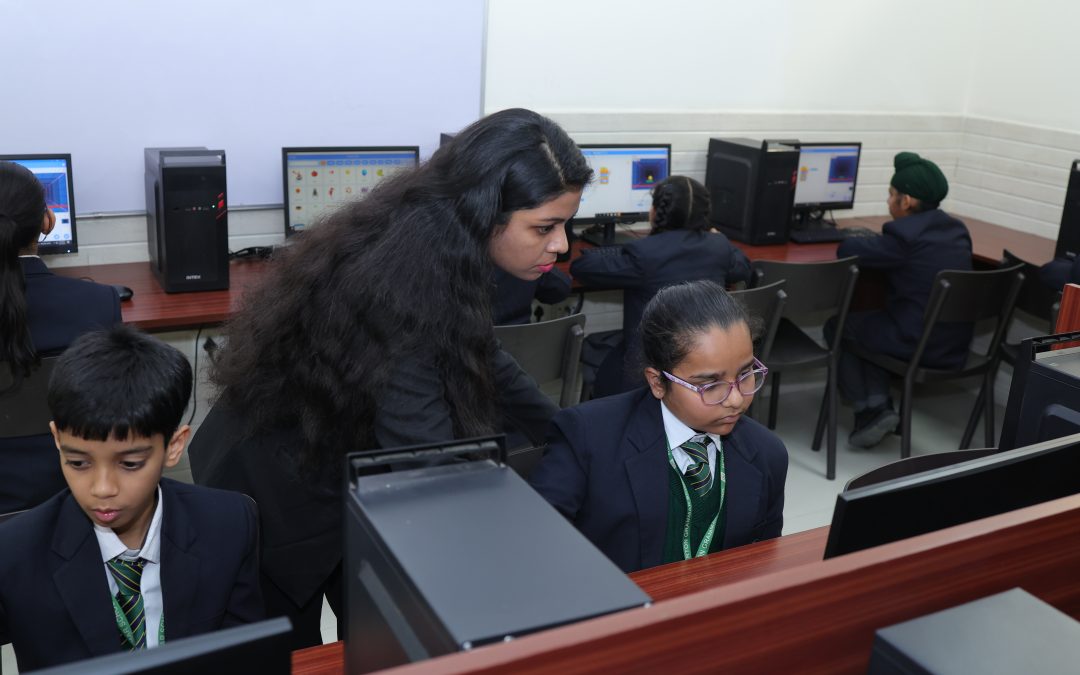
The 21st century is driven by technology. From online classrooms and digital assignments to Artificial Intelligence (AI) and interactive learning platforms, technology has transformed how children learn, communicate, create, and prepare for their future careers. In this rapidly evolving environment, digital literacy for children has become an essential life skill rather than an optional advantage.
Digital literacy goes beyond knowing how to operate a computer, use a smartphone, or browse the internet. It involves understanding how digital tools work, finding and evaluating information, communicating responsibly online, protecting personal information, and using technology creatively to solve problems.
For parents looking for the best CBSE school in Faridabad, digital literacy is an important factor to consider when evaluating a school’s approach to modern education. A school that integrates technology meaningfully into its curriculum can help students develop the confidence, critical thinking, creativity, and adaptability required to succeed in an increasingly digital world.
At Homerton Grammar School, Faridabad, education focuses on preparing students for opportunities beyond the classroom. By recognising the importance of technology-enabled learning and future-ready skills, the school supports an educational approach that encourages students to explore, innovate, collaborate, and become responsible digital citizens.
This article explores the importance of digital literacy for children, the essential digital skills every student needs, and how schools and parents can work together to prepare children for the future.
What is digital literacy?
Digital literacy is the ability to access, understand, evaluate, create, and communicate information using digital technologies safely and effectively.
It includes a combination of technical knowledge, critical thinking, creativity, communication, and responsible online behaviour. A digitally literate student understands not only how to use a digital tool but also when to use it, why it is useful, and what risks may be associated with it.
For example, a digitally literate student can research a school project online, identify reliable sources, organise information, prepare a presentation, acknowledge references, and share the finished work responsibly.
Similarly, when using artificial intelligence tools, students should learn to ask meaningful questions, evaluate the accuracy of generated information, recognise potential biases, and use AI to support learning rather than replace independent thinking.
Digital literacy combines several important competencies:
Technical proficiency: Understanding computers, software, educational applications, and digital platforms.
Information literacy: Finding, analysing, and verifying information online.
Digital communication: Interacting respectfully and effectively through digital channels.
Cybersecurity awareness: Protecting personal information, passwords, and online accounts.
Digital creativity: Using technology to develop presentations, projects, designs, and original content.
Critical thinking: Identifying misinformation, recognising manipulation, and making informed decisions.
Digital citizenship: Understanding online responsibility, privacy, ethics, and respectful behaviour.
Together, these skills empower children to become confident technology users who can participate meaningfully in the digital world.
Why is digital literacy important for children?
1. It prepares students for future careers
Technology has become an integral part of almost every professional field, including healthcare, education, engineering, business, communication, research, and design.
Today’s students may eventually work in careers that use artificial intelligence, robotics, data analytics, automation, or technologies that are still emerging. Although the specific tools may change, the ability to learn new technologies and adapt to unfamiliar digital environments will remain valuable.
Digital literacy introduces children to the foundations of these capabilities at an appropriate stage of their education.
Students who understand digital tools, data, online collaboration, and basic computational thinking may find it easier to explore advanced learning opportunities later.
Schools can help build this foundation through technology-supported lessons, practical assignments, coding activities, research projects, and opportunities to solve real-world problems.
2. It improves the learning experience
Digital technology can make classroom learning more interactive, engaging, and accessible. Teachers can use educational videos, simulations, presentations, virtual demonstrations, and interactive exercises to explain concepts that may otherwise be difficult to understand.
For instance, students studying science can explore visual models of the human body, observe simulated scientific processes, or examine complex concepts through interactive digital resources.
Similarly, digital tools can help students organise notes, practise problem-solving, collaborate on projects, and revisit concepts at their own pace.
When used thoughtfully, technology complements traditional teaching methods and provides additional ways for children to understand and apply what they learn.
3. It develops critical thinking and problem-solving
The internet provides access to an enormous amount of information, but not all of it is accurate, unbiased, or trustworthy.
Students must learn to distinguish between verified facts, personal opinions, advertisements, misleading headlines, and fabricated content.
Digital literacy encourages children to question what they encounter online. They learn to compare sources, examine evidence, identify inconsistencies, and consider different perspectives before accepting information as true.
These habits also strengthen critical thinking beyond the digital environment.
Whether students are preparing a school project, participating in a debate, or evaluating a scientific claim, the ability to analyse information carefully helps them make better decisions.
4. It encourages creativity and innovation
Technology is not simply a medium for consuming information. It also gives children opportunities to create something new.
Students can use digital tools to design presentations, produce educational videos, create digital artwork, develop simple games, record podcasts, and communicate original ideas.
Activities involving coding, robotics, animation, and multimedia storytelling can introduce students to the process of turning an idea into a practical outcome.
Such experiences encourage experimentation, independent thinking, and creative problem-solving.
When children are given opportunities to create rather than merely consume digital content, they begin to see technology as a tool for innovation.
5. It promotes safe and responsible online behaviour
Children increasingly encounter digital platforms for education, entertainment, communication, and social interaction. Without appropriate guidance, they may face risks such as online scams, cyberbullying, misinformation, privacy violations, and inappropriate content.
Digital literacy teaches students how to recognise these risks and respond responsibly.
They learn why personal information should be protected, why passwords must remain confidential, how to identify suspicious links, and why respectful communication matters online.
Equally important, students should understand that they can approach a trusted adult whenever an online interaction makes them uncomfortable or uncertain.
Developing these habits early helps children become more informed and responsible digital citizens.
10 essential digital literacy skills every student needs
1. Basic computer and digital device skills
A strong foundation in digital literacy begins with understanding how to use digital devices effectively.
Students should know how to navigate operating systems, organise files, create folders, use word-processing software, prepare presentations, manage documents, and access educational platforms.
They should also understand basic troubleshooting, such as identifying connectivity issues, saving work correctly, and recognising when they need technical assistance. These practical skills help students complete assignments independently and participate confidently in technology-enabled learning environments.
As children progress through school, they can gradually develop more advanced skills involving spreadsheets, digital collaboration platforms, multimedia tools, and specialised educational applications.
2. Online research and information evaluation
Searching for information online is easy. Finding reliable information requires practice. Students should learn how to use search engines effectively, select appropriate keywords, compare different sources, and identify trustworthy websites. They should also understand the importance of checking the author’s credentials, publication date, supporting evidence, and the purpose behind the information.
For example, while preparing a project on environmental conservation, students could compare information from educational institutions, scientific organisations, government websites, and other credible sources.
Teachers can encourage students to verify important claims instead of relying on the first search result. These research skills improve academic work and prepare children to navigate the growing volume of information available online.
3. Cybersecurity and online safety
Cybersecurity awareness is one of the most important aspects of digital literacy for children. Students need to understand how to protect their digital identities and recognise common online threats.
Essential practices include:
- Creating strong, unique passwords and keeping them private
- Avoiding suspicious links, attachments, and unexpected requests for information
- Never sharing home addresses, passwords, financial details, or other sensitive personal information with strangers online
- Using privacy settings appropriately
- Recognising impersonation, scams, and attempts to obtain confidential information
- Reporting suspicious or uncomfortable online interactions to a trusted adult
Children should also learn that information shared online may be copied, stored, or circulated beyond its original audience. Teaching these principles through age-appropriate examples and regular discussions helps students develop safer digital habits.
4. Digital communication and collaboration
Communication has evolved beyond face-to-face conversations. Students may collaborate through shared documents, educational platforms, video conferences, and digital presentations. Digital literacy helps children understand how to communicate clearly, professionally, and respectfully in these environments.
Students should learn to write appropriate messages, participate constructively in online discussions, listen to different viewpoints, and contribute fairly to collaborative assignments.
They should also understand the importance of digital etiquette, including respecting others’ time, avoiding offensive language, and considering the tone of written communication.
Group projects using digital tools can provide opportunities to practise teamwork, planning, delegation, and constructive feedback. These competencies are useful in school, higher education, and future workplaces.
5. Coding and computational thinking
Coding introduces children to the logic behind digital applications, games, websites, and other software. However, its educational value extends beyond learning a programming language.
Computational thinking involves breaking a complex problem into smaller steps, identifying patterns, creating logical instructions, testing possible solutions, and improving the result. Students can begin with age-appropriate block-based programming activities before progressing to text-based languages when suitable.
For example, they might design a simple animation, create a basic quiz, or programme a small interactive game.
Such activities help develop logical reasoning, persistence, sequencing, and analytical thinking. Coding also provides an introduction to the wider world of software development, automation, robotics, and artificial intelligence.
6. Artificial intelligence awareness
Artificial intelligence is changing how people search for information, generate content, analyse data, and solve problems. As a result, AI literacy is becoming an increasingly important part of digital education.
Students should understand, at an age-appropriate level, what AI can do, how its outputs may be generated, and why those outputs are not always accurate or unbiased.
They should learn to verify AI-generated information, protect personal data when using digital tools, and follow their school’s rules regarding AI-assisted assignments.
Most importantly, students should recognise that AI can support learning but cannot replace human judgement, creativity, empathy, or independent reasoning.
For example, an AI tool may help a student brainstorm ideas for a science project. The student should still research the topic, verify the facts, develop their own understanding, and produce work that reflects their learning. Responsible AI education encourages curiosity while preserving academic integrity.
7. Media literacy and misinformation detection
Digital platforms allow information to spread rapidly, making media literacy essential for school-age children. Students should learn how images, videos, headlines, advertisements, and social media posts can influence people’s opinions. They should be encouraged to examine whether a claim is supported by evidence, whether an image may have been altered, and whether a source is presenting information objectively. They should also understand that convincing-looking content can still be inaccurate or misleading.
Classroom discussions can help students compare different reports about the same event, identify emotionally manipulative language, and distinguish factual reporting from opinion. These skills enable children to approach digital content thoughtfully rather than accepting every online claim at face value.
8. Digital creativity and content creation
Creating digital content helps students express their ideas in different ways. They may prepare presentations, record podcasts, design posters, edit educational videos, create digital illustrations, or develop interactive learning materials.
Such projects combine subject knowledge with communication, planning, technical skills, and creativity. Students should also learn the basics of copyright, plagiarism, attribution, and responsible use of digital images, music, and written content.
Understanding these principles helps children appreciate the value of original work and respect the intellectual property of others.
Digital creativity gives students an opportunity to demonstrate learning beyond traditional written assignments while developing skills that may prove useful in future academic and professional settings.
9. Digital citizenship and online ethics
Digital citizenship refers to the responsible, respectful, and ethical use of technology. Students should understand that their behaviour online can affect other people and that the same standards of kindness and respect apply in digital spaces as they do in everyday life.
Important aspects include avoiding cyberbullying, respecting different viewpoints, seeking permission before sharing someone else’s photographs, and considering the consequences of posting or forwarding content.
Children should also learn about their digital footprint: the information and traces they leave through online activities.
Before publishing something, they can be encouraged to ask whether it is accurate, respectful, appropriate, and safe to share.
By developing these habits, students learn to participate positively in online communities and take responsibility for their digital actions.
10. Data literacy and logical decision-making
Data is used to understand patterns, compare results, measure progress, and make decisions across many fields. Students can begin developing data literacy through simple classroom activities involving tables, charts, graphs, and basic spreadsheets.
For example, they might collect data about reading habits, compare the results of a science experiment, or represent environmental observations in a chart.
These activities teach students how to organise information, interpret patterns, recognise differences, and draw conclusions based on evidence.
As they progress, they can explore more advanced concepts such as data visualisation, statistics, and the role of data in AI systems.
Data literacy helps students move beyond simply collecting information to understanding what it means and how it can be used responsibly.
How can schools develop digital literacy among students?
Schools play a vital role in helping children develop digital competencies through structured learning, guided practice, and responsible technology use.
Digital literacy is most effective when it is integrated into everyday educational experiences rather than treated as an isolated technical subject.
Integrating technology into classroom learning
Teachers can incorporate digital resources into lessons across subjects, helping students understand how technology supports different types of learning.
Interactive presentations, educational videos, virtual demonstrations, and collaborative assignments can make lessons more engaging while allowing students to practise relevant digital skills.
The focus should remain on learning outcomes rather than using technology simply for its novelty.
Providing opportunities for practical learning
Students learn digital skills more effectively when they apply them to meaningful tasks.
Schools can organise research projects, digital presentations, coding activities, multimedia assignments, and collaborative problem-solving exercises.
These experiences allow children to experiment, learn from mistakes, and develop confidence using digital tools.
Introducing robotics, coding, and emerging technologies
Age-appropriate exposure to robotics, coding, and artificial intelligence can help students understand the practical applications of technology.
Such activities can connect scientific concepts with engineering, logical reasoning, creativity, and innovation.
At Homerton Grammar School, Faridabad, the emphasis on future-oriented learning areas, including robotics and AI, aligns with the growing importance of preparing students for a technology-driven world. The effectiveness of these experiences depends on how well practical activities are integrated with conceptual understanding and responsible technology use.
Teaching cyber safety and digital responsibility
Digital safety should be reinforced throughout a student’s school journey. Teachers can discuss online privacy, password security, cyberbullying, misinformation, digital etiquette, and responsible AI use through age-appropriate lessons and classroom activities.
Students should know how to report concerns and where to seek support. Schools can also communicate with parents to reinforce consistent digital safety practices at home and in the classroom.
Encouraging interdisciplinary projects
Digital literacy becomes more meaningful when students apply technology across subjects.
A student might create a presentation about a historical event, use a spreadsheet to analyse scientific observations, design a digital campaign about environmental conservation, or develop a simple coded solution to a classroom problem.
Interdisciplinary activities demonstrate that digital skills are relevant to multiple areas of learning and encourage students to make connections between concepts.
The role of parents in building digital literacy
While schools provide structured learning opportunities, parents also play an important role in shaping children’s digital habits. A supportive home environment helps students learn to use technology with confidence, awareness, and balance.
1. Encourage purposeful screen use
Not all screen time serves the same purpose. Educational research, creative activities, video lessons, entertainment, and passive browsing offer different experiences. Parents can encourage children to use digital devices for meaningful learning and creativity while maintaining appropriate boundaries around recreational screen use. The aim should be balanced technology use rather than eliminating digital experiences altogether.
2. Discuss online safety regularly
Parents should have open, age-appropriate conversations about online risks. Children need to understand why they should protect personal information, avoid interacting carelessly with strangers, and seek help if something online makes them uncomfortable. A supportive approach makes it easier for children to report problems without fear of embarrassment or disproportionate punishment.
3. Promote critical thinking
When children encounter surprising claims, viral videos, or online advertisements, parents can encourage them to ask questions.
- Who created this content?
- What evidence supports it?
- Could another source provide a different perspective?
These simple discussions help children develop the habit of checking information before believing or sharing it.
4. Support digital creativity
Parents can encourage children to explore age-appropriate tools for drawing, storytelling, coding, music, photography, and presentations. The objective is not to make every child a technology expert but to help them discover how digital tools can support their interests and ideas.
5. Model responsible technology use
Children often learn from the behaviour they observe. Parents who respect privacy, communicate thoughtfully online, verify information, and maintain healthy device habits can reinforce the same values in their children. Family conversations about technology can help establish shared expectations and encourage responsible digital behaviour.
Digital literacy and CBSE education: Preparing students for the future
For families exploring CBSE schools in Faridabad, it is worth considering how digital literacy fits into a school’s broader educational approach.
The Central Board of Secondary Education has introduced and supported various technology-related educational initiatives, including digital learning resources and skill-oriented education. The National Education Policy 2020 also emphasises the importance of digital literacy, computational thinking, and the appropriate integration of technology into education.
However, digital literacy is broader than learning computer applications or completing a technology-related subject.
Students benefit when digital competencies are reinforced across the curriculum and connected with communication, problem-solving, research, creativity, ethics, and real-world applications.
A future-ready educational environment should encourage students to:
- Use technology to deepen subject understanding
- Evaluate information instead of memorising online content
- Develop logical reasoning through practical problem-solving
- Understand the opportunities and limitations of AI
- Collaborate effectively through digital tools
- Protect their privacy and respect the rights of others
- Apply digital skills to creative and meaningful projects
Such an approach supports the development of adaptable learners who can continue building their skills as technology evolves.
Challenges in teaching digital literacy to children
Despite its importance, digital literacy education comes with certain challenges.
Information overload
The vast amount of online content can make it difficult for children to distinguish relevant, accurate information from unreliable material.
Schools can address this by teaching source evaluation, structured research methods, and evidence-based reasoning.
Cybersecurity and privacy risks
Children may not always recognise phishing attempts, deceptive websites, or requests for personal information.
Regular safety discussions, clear reporting procedures, and age-appropriate guidance can help reduce these risks.
Overdependence on technology
Excessive reliance on digital tools may limit opportunities for independent thinking, face-to-face communication, physical activity, and hands-on experiences.
A balanced educational approach combines digital learning with books, discussions, outdoor activities, experiments, sports, and creative work.
Unequal access to devices and connectivity
Not every student has the same access to computers, reliable internet connections, or digital learning resources at home.
Schools can help address this challenge by providing appropriate learning opportunities, guidance, and access to educational resources wherever possible.
Keeping up with emerging technologies
Digital platforms and AI tools evolve rapidly, making it challenging for students, parents, and educators to stay informed.
Schools and families should therefore focus on enduring principles such as critical thinking, privacy, ethical decision-making, adaptability, and responsible technology use, alongside learning specific tools.
How to recognise a school that supports digital literacy?
Parents evaluating schools can look beyond the presence of computer labs or smart classrooms and examine how technology is actually used to support learning.
Consider asking the following questions:
- Does the school integrate digital resources into different subjects?
- Are students given opportunities to practise research, presentations, coding, or digital creation?
- Does the curriculum introduce age-appropriate concepts related to robotics, AI, or computational thinking?
- Are online safety, privacy, and digital citizenship addressed?
- Are students taught to evaluate online information and use AI responsibly?
- Does technology encourage independent thinking and collaboration rather than passive consumption?
- Does the school maintain a balance between digital learning, physical activity, social interaction, and hands-on experiences?
- Are teachers supported in using technology meaningfully and responsibly?
These questions can help parents assess whether a school’s approach prepares students for the realities of modern education and the workplace.
At Homerton Grammar School, Faridabad, parents can explore how the school’s technology-enabled learning opportunities and future-oriented educational initiatives fit into its wider approach to academic development, creativity, practical learning, and student growth.
The future of digital literacy: Beyond devices and applications
As technology continues to evolve, the definition of digital literacy will also expand.
Artificial intelligence, automation, immersive learning environments, data-driven decision-making, and new communication platforms will create additional opportunities and challenges for future generations.
Students will need to learn how to work alongside intelligent tools, evaluate machine-generated information, recognise digital risks, and adapt to unfamiliar technologies.
However, the most important skills will not be technical alone.
Curiosity, empathy, ethical judgement, collaboration, resilience, creativity, and independent thinking will remain essential. Technology can support these qualities, but children need meaningful educational experiences and human guidance to develop them.
The goal of digital literacy education should therefore be to prepare students not merely to use today’s tools but to become thoughtful learners who can adapt to tomorrow’s possibilities.
Conclusion: Building future-ready learners at Homerton Grammar School
Digital literacy is an essential part of preparing children for the opportunities and responsibilities of the 21st century. From online research and cybersecurity to coding, artificial intelligence, digital creativity, and responsible communication, these skills help students learn more effectively and participate confidently in a technology-driven society.
Developing digital literacy requires a collaborative effort involving schools, teachers, parents, and students. When technology is integrated meaningfully into education, it can strengthen critical thinking, encourage innovation, support collaboration, and equip children to navigate an increasingly complex digital environment.
For parents searching for a progressive CBSE school in Faridabad, it is important to consider how a school balances academic foundations with practical digital competencies, creative exploration, ethical awareness, and holistic development.
Homerton Grammar School, Faridabad, recognises the importance of preparing students for a changing world through an educational approach that values learning, innovation, and future-ready skills. By encouraging students to explore technology responsibly and apply their knowledge meaningfully, the school supports the broader goal of developing confident, capable, and adaptable learners.
Because the future belongs not simply to those who can use technology, but to those who can think critically, create responsibly, and use it to make a positive difference.