
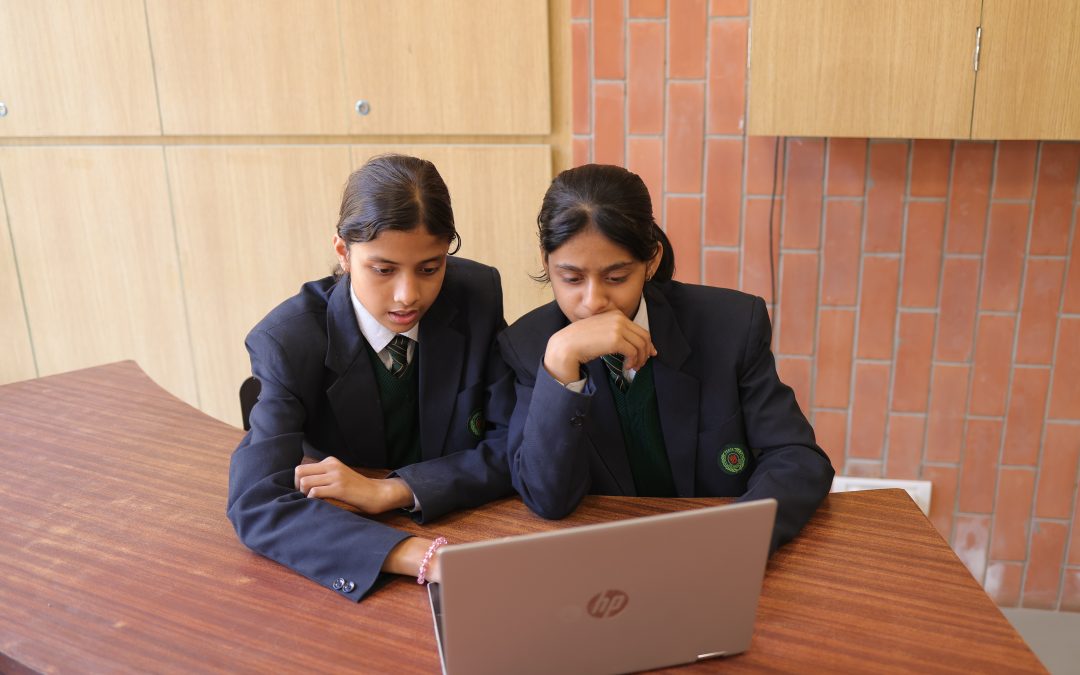
Class 11 is an important transition in a student’s academic journey. After completing Class 10, students begin to move towards specialised subject combinations that can influence their learning experience in Classes 11 and 12 and help them explore potential higher-education pathways.
For parents searching for schools in Faridabad, choosing a school for Class 11 involves more than looking at the stream offered. Families may also want to consider the school’s academic approach, subject choices, laboratories and learning resources, faculty support, counselling, extracurricular opportunities, sports facilities and the overall environment in which students will spend their senior-secondary years.
For students, the most important starting point is understanding the difference between Science, Commerce and Humanities and considering which subjects align with their interests, strengths and future plans.
The Central Board of Secondary Education (CBSE) senior-secondary curriculum includes languages, sciences, mathematics, humanities and social sciences, skill subjects, general studies, and health and physical education. The current CBSE framework also allows combinations of academic and skill electives, subject to the applicable scheme of studies and the subjects a school offers.
This means choosing Class 11 is not simply about selecting the stream that someone else recommends. It is about understanding the available options and making a considered decision.
What should students consider before choosing a Class 11 stream?
Before discussing individual streams, students and parents can consider several factors.
1. Interests
What subjects does the student genuinely enjoy?
A student who enjoys understanding scientific concepts may naturally be interested in Science. Someone interested in markets, entrepreneurship or financial concepts may explore Commerce, while a student fascinated by history, society, politics, geography or human behaviour may find Humanities appealing. Interest can make sustained learning more engaging.
2. Academic strengths
Students should look at their performance across different subjects rather than focusing only on their overall percentage.
For example:
- Mathematics and Science strengths may support a Science combination
- Mathematics, Economics and analytical interests may align with Commerce
- Strong reading, writing, analysis and interest in social sciences may support Humanities
These are broad indicators, not fixed rules. Students can have varied strengths and interests.
3. Future study plans
Students who already have a particular higher-education goal can research the subject requirements associated with it. However, students who are undecided do not necessarily need to have their entire career mapped out before entering Class 11. Senior secondary education can also be a period of exploration.
4. School’s subject combinations
Different schools may offer different combinations. CBSE’s current senior-secondary framework permits academic and skill electives in specified combinations, but individual schools determine which subjects and combinations they actually offer. Therefore, parents should check the school’s current Class 11 subject options rather than assuming that every school offers the same combinations.
Understanding the Science stream
Science is often associated with careers in medicine, engineering and technology, but the stream encompasses much more. CBSE’s senior-secondary Science curriculum includes subjects such as Physics, Chemistry, Biology, Computer Science and Informatics Practices, depending on the student’s chosen combination and the school’s offerings.
Who may enjoy Science?
Science may appeal to students who enjoy:
- Understanding how things work
- Experiments and practical activities
- Mathematics and logical reasoning
- Biology and life sciences
- Technology
- Problem-solving
- Scientific investigation
Students should remember that Science can involve substantial conceptual learning, regular practice and analytical thinking.
What can students explore after Science?
Depending on their subjects and subsequent qualifications, Science students may explore areas such as:
- Medicine and healthcare
- Engineering
- Computer science
- Biotechnology
- Pure sciences
- Environmental science
- Architecture
- Research
- Data and technology-related fields
The appropriate pathway depends on the student’s subjects, entrance requirements and higher-education choices.
Why practical learning matters in Science?
Science is particularly suited to experiential learning. Laboratory work, experiments, demonstrations and project-based activities can help students connect theoretical concepts with observation and application.
When choosing a school for Class 11 in Faridabad, parents considering Science may therefore want to ask about the school’s laboratories, practical facilities, science faculty and opportunities for project-based learning.
Understanding the Commerce stream
Commerce introduces students to areas connected with business, economics, accounting and financial systems. Depending on the school’s subject combinations, students may encounter subjects such as Accountancy, Business Studies, Economics, Mathematics and related electives.
Commerce can appeal to students interested in understanding how businesses operate and how financial and economic systems work.
Who may enjoy Commerce?
Commerce may be suitable for students who enjoy:
- Business concepts
- Economics
- Mathematics or quantitative reasoning
- Finance
- Entrepreneurship
- Analysis
- Organisation
- Understanding how markets work
Commerce is not simply about becoming an accountant. It can provide a foundation for exploring a broad range of academic and professional areas.
What can students explore after Commerce?
Depending on their subject choices and future qualifications, students may explore:
- Accounting
- Finance
- Business management
- Economics
- Entrepreneurship
- Banking and financial services
- Marketing
- Management studies
- Law
- Business analytics
Students should research the specific eligibility requirements for their intended university or professional programme.
Understanding the Humanities stream
Humanities and social sciences cover subjects that help students understand people, societies, cultures, environments and institutions. CBSE identifies areas including History, Geography, Economics, Sociology, Political Science, Fine Arts and related subjects within the humanities and social sciences curriculum.
Who may enjoy Humanities?
Humanities may appeal to students who enjoy:
- History
- Geography
- Political Science
- Sociology
- Economics
- Literature
- Writing
- Current affairs
- Understanding people and society
- Research and discussion
Students who enjoy asking questions about why societies develop in particular ways or how people and institutions interact may find Humanities particularly engaging.
What can students explore after Humanities?
Humanities can provide foundations for many higher-education pathways, including:
- Law
- Social sciences
- Psychology
- Journalism and mass communication
- International relations
- Public policy
- History
- Political science
- Economics
- Design and creative fields
- Education
- Civil services preparation
Again, future pathways depend on the student’s chosen subjects and the admission requirements of specific institutions.
Science vs Commerce vs Humanities: What is the difference?
Rather than thinking of one stream as universally better than another, students can compare the nature of learning involved.
| Stream | Common Areas of Study | May Appeal to Students Interested In |
| Science | Physics, Chemistry, Biology, Mathematics, Computer Science | Scientific concepts, technology, medicine, engineering, research |
| Commerce | Accountancy, Business Studies, Economics, Mathematics | Business, finance, economics, entrepreneurship |
| Humanities | History, Political Science, Geography, Sociology, Economics | Society, culture, politics, people, communication and research |
The exact subject combinations vary by school and the applicable CBSE scheme.
The objective should not be to select a stream based on its perceived status. Instead, students can look at where their interests, abilities and aspirations intersect.
Why does the school matter as much as the stream?
Choosing Science, Commerce or Humanities is only one part of the Class 11 decision. The school environment also matters.
A strong senior-secondary programme can provide students with:
- Experienced subject teachers
- Academic guidance
- Counselling
- Practical learning
- Laboratories
- Technology resources
- Library access
- Sports
- Arts and cultural activities
- Leadership opportunities
- Career guidance
- A supportive learning environment
For families researching schools in Faridabad, visiting schools and speaking with academic teams can provide useful information about what each institution offers for Classes 11 and 12.
Homerton Grammar School for senior secondary education
One of the schools parents can consider when researching schools in Faridabad is Homerton Grammar School, located in Sector 21A, Faridabad. Homerton Grammar School provides a broader educational environment that combines academics with opportunities in sports, arts, technology, communication and leadership.
For students entering the senior-secondary years, this broader environment can be relevant because Class 11 and 12 are not only about subject-specific learning. They are also years when students increasingly develop independence, communication skills, study habits and clarity about higher education.
The school provides access to learning areas including science laboratories, IT and robotics facilities, music, art and sports opportunities. These facilities can complement classroom education by allowing students to explore practical and extracurricular interests.
Parents should, however, check the school’s current Class 11 subject combinations, eligibility requirements, admission criteria and availability directly with the school, as offerings can change from one academic session to another.
Importance of career counselling in Class 11
Students do not always know what career they want at the age of 15 or 16. That is completely normal.
Career counselling can help students understand:
- Their interests
- Academic strengths
- Potential study pathways
- Subject requirements
- Higher-education options
- Skills they may need to develop
Good counselling should provide information rather than simply telling a student which stream to choose.
Students and parents can use counselling as one input alongside academic performance, personal interests and research.
Don’t choose a stream because of peer pressure
One of the most common challenges students face after Class 10 is comparison. A friend chooses Science, so another student feels they should choose Science too. A relative believes Commerce is the safest option. Someone else says Humanities has fewer opportunities. Such generalisations can make stream selection unnecessarily stressful. Every stream has multiple higher-education and career pathways.
The more useful question is: “Which combination of subjects is appropriate for this student’s interests, strengths and future plans?”
Avoid choosing a stream only on the basis of marks
Academic performance is relevant, but marks alone should not determine the decision. A student may achieve high marks in several subjects but enjoy one area significantly more than another. Likewise, a student may initially struggle with a subject but demonstrate strong interest and willingness to improve.
Parents can consider the broader picture: Interest + Aptitude + Academic Performance + Future Plans + Willingness to Learn
This can lead to a more informed decision than focusing on one examination result.
Why infrastructure matters for Class 11 students?
As students move into senior secondary education, specialised learning resources become increasingly relevant.
For Science students, parents can look at:
- Physics laboratories
- Chemistry laboratories
- Biology laboratories
- Safety arrangements
- Practical equipment
- Technology integration
For Commerce and Humanities students, parents can consider:
- Libraries
- Digital resources
- Presentation opportunities
- Research activities
- Discussion-based learning
- Technology facilities
A school’s infrastructure should support the subjects it offers rather than simply serving as a measure of appearance.
Look beyond academics
Classes 11 and 12 can be academically demanding, but students also benefit from maintaining interests outside their subjects.
Sports can support teamwork and discipline. Arts can provide creative expression. Clubs and competitions can develop communication and collaboration. Leadership activities can encourage responsibility.
CBSE’s curriculum itself includes Health and Physical Education, General Studies and Work Experience alongside academic and skill electives in senior secondary education. This reflects a broader approach to senior-secondary education rather than a focus exclusively on examinations.
Questions parents should ask schools before Class 11 admission
When visiting a school, parents can ask:
About subjects
- Which Science combinations are available?
- Which Commerce combinations are available?
- Which Humanities subjects are offered?
- Are skill subjects available?
- What are the eligibility criteria?
About academics
- What is the teaching approach?
- How are students supported academically?
- What practical learning opportunities are available?
About career planning
- Is career counselling available?
- Are students guided about higher-education pathways?
- Does the school organise university or career events?
About student development
- What sports are available?
- What extracurricular activities are offered?
- Are there leadership opportunities?
- How does the school support student wellbeing?
About admissions
- What documents are required?
- What is the admission process?
- Are there stream-specific requirements?
- What are the current fees and other applicable charges?
These questions can help parents compare schools based on relevant information.
How can students prepare for Class 11?
Students can also take an active role in the process.
Make a subject list: Write down the subjects you enjoy most and least
Identify strengths: Think about areas where you naturally perform well
Research career areas: Explore different fields without feeling pressured to make a final decision immediately
Speak to teachers: Teachers can provide useful insight into your academic performance and learning habits
Talk to a counsellor: A qualified counsellor can help you explore options systematically
Check eligibility requirements: If you already have a higher-education goal, research the subjects required for that pathway
Visit schools: A school visit can help students understand the environment, facilities and academic support available
Is Science better than Commerce or Humanities?
There is no universally superior stream. Science, Commerce and Humanities serve different academic interests and can lead towards different higher-education pathways. The right choice depends on the individual student.
For one student, Science may provide the appropriate foundation. Another may find Commerce more aligned with their interests, while someone else may thrive in Humanities. The important thing is to make the decision based on information rather than assumptions.
The role of parents in Class 11 stream selection
Parents can support students by becoming partners in the decision-making process.
Instead of saying, “You should take Science,” parents can ask:
- “What subjects do you enjoy?”
- “What do you find interesting?”
- “Which subjects do you want to explore further?”
- “What careers or courses are you curious about?”
- “What support do you need to make your decision?”
This approach gives students an opportunity to understand their own preferences while benefiting from parental experience and guidance.
Final checklist for choosing a Class 11 school in Faridabad
Before finalising a school, consider:
- CBSE affiliation and applicable curriculum
- Available subject combinations
- Academic faculty
- Laboratories and learning resources
- Career counselling
- Technology facilities
- Library resources
- Sports and extracurricular activities
- Leadership opportunities
- Student support
- School location and commute
- Fee structure
- Admission criteria
- Overall learning environment
Families can compare schools such as Homerton Grammar School, Manav Rachna International School, Delhi Public School and other senior-secondary institutions in Faridabad based on the factors that matter to their child. This should be treated as a starting point for research rather than a ranking of schools.
Conclusion
Choosing the right school for Class 11 is an important decision because senior secondary education introduces students to more specialised academic learning while preparing them for higher education.
Science, Commerce and Humanities each offer distinctive areas of study and potential pathways. The right choice depends on the student’s interests, academic strengths, aspirations and the subject combinations available at the school.
For parents researching schools in Faridabad, the decision should therefore involve two connected questions: Which stream is appropriate for my child? And which school can provide the academic environment and support my child needs during Classes 11 and 12?
Homerton Grammar School is one of the senior-school options families can explore in Faridabad. Its broader educational environment combines academics with opportunities in sports, arts, technology, communication and leadership. Parents should verify the latest Class 11 offerings and admission details directly with the school before making a decision.
Ultimately, Class 11 is not about choosing the stream that sounds most impressive. It is about choosing an academic direction that allows a student to learn with interest, develop relevant skills and prepare thoughtfully for the next stage of education.